CATALYTIC CRACKING

INTRODUCTION

Fluid catalytic cracking (FCC) technology is a technology with more than 60 years of commercial operating experience. The process is used to convert higher-molecular-weight hydrocarbons to lighter, more valuable products through contact with a powdered catalyst at appropriate conditions. Historically, the primary purpose of the FCC process has been to produce gasoline, distillate, and C3/C4 olefins from low-value excess refinery gas oils and heavier refinery streams. FCC is often the heart of a modern refinery because of its adaptability to changing feedstocks and product demands and because of high margins that
exist between the FCC feedstocks and converted FCC products. As oil refining has evolved
over the last 60 years, the FCC process has evolved with it, meeting the challenges of cracking heavier, more contaminated feedstocks, increasing operating flexibility, accommodating environmental legislation, and maximizing reliability.
The FCC unit continuously circulates a fluidized zeolite catalyst that allows rapid
cracking reactions to occur in the vapor phase. The KBR Orthoflow FCC unit (Fig. 3.1.1)
consists of a stacked disengager-regenerator system that minimizes plot space requirements. The cracking reactions are carried out in an up-flowing vertical reactor-riser in
which a liquid oil stream contacts hot powdered catalyst. The oil vaporizes and cracks to
lighter products as it moves up the riser and carries the catalyst along with it. The reactions
are rapid, requiring only a few seconds of contact time. Simultaneously with the desired
reactions, coke, a material having a low ratio of hydrogen to carbon, deposits on the catalyst
and renders it less catalytically active. Catalyst and product vapors separate in a disengaging vessel with the catalyst continuing first through a stripping stage and second
through a regeneration stage where coke is combusted to rejuvenate the catalyst and provide heat for operation of the process. The regenerated catalyst then passes to the bottom of the reactor-riser, where the cycle starts again. Hydrocarbon product vapors flow downstream for separation into individual products.
KBR, through its ancestry in The M.W. Kellogg Company, has been a leader in FCC
technology developments since the inception of the process. In recent years, KBR has
worked with its FCC partner, ExxonMobil, to create and refine FCC technology features
that have led the industry. To date, KBR has licensed more than 120 grassroots FCC


units throughout the world, including 13 grassroots units and more than 120 revamps
since just 1990.
FEEDSTOCKS

The modern FCC unit can accept a broad range of feedstocks, a fact which contributes to
FCC’s reputation as one of the most flexible refining processes in use today. Examples of
common feedstocks for conventional distillate feed FCC units are
● Atmospheric gas oils
● Vacuum gas oils
● Coker gas oils
● Thermally cracked gas oils
● Solvent deasphalted oils
● Lube extracts
● Hydrocracker bottoms

Residual FCCU (RFCCU) processes Conradson carbon residue and metals-contaminated
feedstocks such as atmospheric residues or mixtures of vacuum residue and gas oils.
Depending on the level of carbon residue and metallic contaminants (nickel and vanadium),
these feedstocks may be hydrotreated or deasphalted before being fed to an RFCCU.
Feed hydrotreating or deasphalting reduces the carbon residue and metals levels of the
feed, reducing both the coke-making tendency of the feed and catalyst deactivation.
PRODUCTS
Products from the FCC and RFCC processes are typically as follows:
● Fuel gas (ethane and lighter hydrocarbons)
● C3 and C4 liquefied petroleum gas (LPG)
● Gasoline
● Light cycle oil (LCO)
● Fractionator bottoms (slurry oil)
● Coke (combusted in regenerator)
● Hydrogen Sulfide (from amine regeneration)

Although gasoline is typically the most desired product from an FCCU or RFCCU, design
and operating variables can be adjusted to maximize other products. The three principal
modes of FCC operation are (1) maximum gasoline production, (2) maximum light cycle
oil production, and (3) maximum light olefin production, often referred to as maximum
LPG operation. These modes of operation are discussed below:
Maximum Gasoline The maximum gasoline mode is characterized by use of an intermediate cracking temperature (510 to 540°C), high catalyst activity, and a high catalyst/oil ratio. Recycle is normally not used since the conversion after a single pass through the riser is already high. Maximization of gasoline yield requires the use of an effective feed injection system, a short-contact-time vertical riser, and efficient riser effluent separation to maximize the cracking selectivity to gasoline in the riser and to prevent secondary reactions from degrading the gasoline after it exits the riser.
Maximum Middle Distillate The maximum middle distillate mode of operation is a low-cracking-severity operation in which the first pass conversion is held to a low level to restrict recracking of light cycle oil formed during initial cracking. Severity is lowered by reducing the riser outlet temperature (below 510°C) and by reducing the catalyst/oil ratio. The lower catalyst/oil ratio is often achieved by the use of a fired feed heater which significantly increases feed temperature. Additionally catalyst activity is sometimes lowered by reducing the fresh catalyst makeup rate or reducing fresh catalyst activity. Since during low-severity operation a substantial portion of the feed remains unconverted in a single pass through the riser, recycle of heavy cycle oil to the riser is used to reduce the yield of lower-value, heavy streams such as slurry product. When middle distillate production is maximized, upstream crude distillation units are operated to minimize middle distillate components in the FCCU feedstock, since these components either degrade in quality or convert to gasoline and lighter products in the FCCU. In addition, while maximizing middle distillate production, the FCCU gasoline endpoint would typically be minimized within middle distillate flash point constraints, shifting gasoline product into LCO.
If it is desirable to increase gasoline octane or increase LPG yield while also maximizing
LCO production, ZSM-5 containing catalyst additives can be used. ZSM-5 selectively
cracks gasoline boiling-range linear molecules and has the effect of increasing gasoline
research and motor octane ratings, decreasing gasoline yield, and increasing C3 and C4
LPG yield. Light cycle oil yield is also reduced slightly.
Maximum Light Olefin Yield
The yields of propylene and butylenes may be increased above that of the maximum gasoline operation by increasing the riser temperature above 540°C and by use of ZSM-5 containing catalyst additives. The FCC unit may also be designed specifically to allow
maximization of propylene as well as ethylene production by incorporation of MAXOFIN
FCC technology, as described more fully in the next section. While traditional FCC operations typically produce less than 6 wt % propylene, the MAXOFIN FCC process can produce as much as 20 wt % or more propylene from traditional FCC feedstocks. The process increases propylene yield relative to that produced by conventional FCC units by combining the effects of MAXOFIN-3 catalyst additive and proprietary hardware, including a second high-severity riser designed to crack surplus naphtha and C4’s into incremental light
olefins. Table 3.1.1 shows the yield flexibility of the MAXOFIN FCC process that can
alternate between maximum propylene and traditional FCC operations.

PROCESS DESCRIPTION

The FCC process may be divided into several major sections, including the converter section, flue gas section, main fractionator section, and vapor recovery units (VRUs). The
number of product streams, the degree of product fractionation, flue gas handling steps,
and several other aspects of the process will vary from unit to unit, depending on the
requirements of the application. The following sections provide more detailed descriptions
of the converter, flue gas train, main fractionator, and VRU.
Converter
The KBR Orthoflow FCCU converter shown in Fig. 3.1.2 consists of regenerator, stripper,
and disengager vessels, with continuous closed-loop catalyst circulation between the
regenerator and disengager/stripper. The term Orthoflow derives from the in-line stacked
arrangement of the disengager and stripper over the regenerator. This arrangement has the
following operational and cost advantages:
● Essentially all-vertical flow of catalyst in standpipes and risers
● Short regenerated and spent catalyst standpipes allowing robust catalyst circulation
● Uniform distribution of spent catalyst in the stripper and regenerator
● Low overall converter height
● Minimum structural steel and plot area requirements
Preheated fresh feedstock, plus any recycle feed, is charged to the base of the riser reactor.
Upon contact with hot regenerated catalyst, the feedstock is vaporized and converted to lower boiling fractions (light cycle oil, gasoline, C3 and C4 LPG, and dry gas). Product vapors are separated from spent catalyst in the disengager cyclones and flow via the disengager
overhead line to the main fractionator and vapor recovery unit for quenching and fractionation.
Coke formed during the cracking reactions is deposited on the catalyst, thereby reducing
its activity. The coked catalyst, which is separated from the reactor products in the
disengager cyclones, flows via the stripper and spent catalyst standpipe to the regenerator.
The discharge rate from the standpipe is controlled by the spent catalyst plug valve.
In the regenerator, coke is removed from the spent catalyst by combustion with air. Air
is supplied to the regenerator air distributors from an air blower. Flue gas from the combustion of coke exits the regenerator through two-stage cyclones which remove all but a
trace of catalyst from the flue gas. Flue gas is collected in an external plenum chamber and
flows to the flue gas train. Regenerated catalyst, with its activity restored, is returned to the
riser via the regenerated catalyst plug valve, completing the cycle.

 ATOMAX Feed Injection System
The Orthoflow FCC design employs a regenerated catalyst standpipe, a catalyst plug
valve, and a short inclined lateral to transport regenerated catalyst from the regenerator to
the riser. The catalyst then enters a feed injection cone surrounded by multiple, flat-spray, atomizing feed injection nozzles, as shown in Fig. 3.1.3. The flat, fan-shaped sprays provide
uniform coverage and maximum penetration of feedstock into catalyst, and prevent catalyst
from bypassing feed in the injection zone. Proprietary feed injection nozzles, known
as ATOMAX nozzles, are used to achieve the desired feed atomization and spray pattern
while minimizing feed pressure requirements. The hot regenerated catalyst vaporizes the
oil feed, raises it to reaction temperature, and supplies the necessary heat for cracking.
The cracking reaction proceeds as the catalyst and vapor mixture flow up the riser. The
riser outlet temperature is controlled by the amount of catalyst admitted to the riser by the
catalyst plug valve.

Riser Quench
The riser quench system consists of a series of nozzles uniformly spaced around the upper
section of riser. A portion of the feed or a recycle stream from the main fractionator is
injected through the nozzles into the riser to rapidly reduce the temperature of the riser
contents. The heat required to vaporize the quench is supplied by increased fresh feed preheat or by increased catalyst circulation. This effectively increases the temperature in the
lower section of the riser above that which would be achieved in a nonquenched operation,
thereby increasing the vaporization of heavy feeds, increasing gasoline yield, olefin production, and gasoline octane.
Riser Termination
At the top of the riser, all the selective cracking reactions have been completed. It is important to minimize product vapor residence time in the disengager to prevent unwanted thermal or catalytic cracking reactions which produce dry gas and coke from more valuable
products. Figure 3.1.4 shows the strong effect of temperature on thermal recracking of
gasoline and distillate to produce predominantly dry gas.
Closed cyclone technology is used to separate product vapors from catalyst with minimum
vapor residence time in the disengager. This system (Fig. 3.1.5) consists of riser
cyclones directly coupled to secondary cyclones housed in the disengager vessel. The riser
cyclones effect a quick separation of the spent catalyst and product vapors exiting the
riser. The vapors flow directly from the outlet of the riser cyclones into the inlets of the


secondary cyclones and then to the main fractionator for rapid quenching. Closed cyclones
almost completely eliminate postriser thermal cracking with its associated dry gas and
butadiene production. Closed cyclone technology is particularly important in operation at
high riser temperatures (say, 538°C or higher), typical of maximum gasoline or maximum
light olefin operations.


Chapter 2: Casing Design con't lec (10 )


Cementing

Cementing a liner in place requires very closely controlled application of existing technology4s46 and a fair amount of risk. Three cementing methods are generally accepted for liners.47 Calculating the volume of cement to be used in a liner cementing job is extremely difficult and requires more information than available from a simple caliper run. For maximum caliper information, a four arm device capable of determining elliptical holes should be utilized for hole volume. Cement excesses of between 20% and 100% have been used on a number of liner jobs with larger excesses being responsible for better bonding and less channels. There is also a direct correlation with absence of channels and pipe movement. In liners of 500 ft or less, Bowman and Sherer4s46 recommend 100% excess
over the calculated annular volume and on liners of 3000 ft or more at least a 30% excess is recommended. A single-stage cementing job in which cement is circulated to the top of a liner; much like a


primary cement job and may include pipe movement during cementing. A planned squeeze program in which the lower part of the liner is cemented and the top part of the liner is squeezed later. This technique does not have good middle support and should not be used to isolate high pressure zones. The procedure is more widely followed in worldwide operations because of perceived problems of disengaging the liner running assembly from the liner and of flash setting of cement. Disengaging from the liner before cementing eliminates the ability to move the liner and almost universally results in poor cement jobs.
A third procedure commonly reserved for short liners is to fill part of the hole with cement and then slowly run the casing string into the cement, forcing the cement to flow up around the pipe. While this method can be accomplished with the minimum amount of pumping, the lack of circulation can result in poor removal of drilling mud. The technique is called a puddle job. Most liner jobs do not include plans to move the liner during the primary ~ e m e n t i n g .T~h~e ?re~as~o ns for this include:
1. Detaching the drill pipe from the liner before cementing minimizes the risk of being unable to detach from the liner once the cement is in place.
2. It may be necessary to change to a higher strength drillstring to allow pipe movement.
3. Movement may cause the liner hanger to become tangled with the centralizers near the top of the string.
4. Swab or surge pressures may be created during liner movement, especially in close tolerance wellbores.
5. Movement of the liner during cementing may knock off debris from the borehole wall. The debris may cause bridges and reduce the possibility of circulating cement. Despite the quoted disadvantages of staying attached during the cementing operation, Bowman and
Sherer4346 site several serious disadvantages with releasing the liner before cementing.

1. If the liner is hung off, the small bypass area around the liner offers a greater restriction to flow and causes more lost circulation because of the backpressure on the flowing cement.
2. If a downhole rotating liner hanger is used (rotation only), additional torque is required to initiate rotation to overcome bearing friction. Pipe often rotates easier when it is being raised or lowered. The difference in torque required is often substantial.
3. The potential for sloughing shale and annulus bridging is lessened when the operator can alternate between rotation and reciprocation.
4. Premature shearing of the pins in the liner-wiper plug is less likely because there is no relative movement between the liner and the setting tool (these two pieces of equipment move together). 49
5. If cement channels and there is a large hydrostatic pressure difference between inside and outside of the running tools, the cups or seals can give way before cementing of the liner is complete.
6. The displacement efficiency of cement around the tubulars when pipe is not moved is lessened. When liners are close clearance, then the density differences between mud and cement should be as close as possible. This negates the advantages of hole cleaning by higher density cement. Reciprocation4’ of the string is helpful because it produces lateral pipe movement that causes the pipe to change sides in the wellbore while it is alternately compressed and stretched (slacked off and picked up).43 R o t a t i ~ hnelp~s b~y ~mix~in~g th~e ~cem ent into wellbore irregularities and displacing mud due to drag forces produced by the flowing cement.43 Although liner movement should be a goal in any liner operation, well conditions may prevent any type of movement. In many cases, however, liner movement can be achieved in a well conditioned hole. Two clear cases where liner should not be moved are:43
1. When a short or small liner (3-1/2 in. or smaller) is run in a deep well, the liner should be hung off first since it may be impossible to tell from the weight indicator whether the liner had been released from the drill pipe.
2. In cases of hole deviation over 35O, reciprocation may be difficult due to high drag forces.
Many of the problems in liner running can be lessened by drilling a usable hole. Problems with keyseats, ledges, washouts, and other nongauge problems intensify when close tolerance liners are to be run. For additional information on problems involved in drilling a usable hole, refer to the chapter on Drilling The Pay.
When cement is circulated from the liner bottom to over the liner top, the cement must remain fluid long enough to detach from the liner and to circulate the cement from the well or to pull up above the top of the cement with the drillstring. If the cement flash sets, then the drillstring will become cemented in place and the hole most likely will be lost. Cement may prematurely set, thicken, or cement circulation may be lost for a number of reasons
1. Improper thickening or pump times caused by a poor design, ineffective field operations, or bad test results.
2. Poor density control on the cement or poor mixing of the cement at the surface. ,
3. Bridging in the annulus caused by a buildup of cuttings. This is caused typically by the increased number of particles picked up by higher annular velocities with a liner in the hole (due to its larger ID) than around the drillstring.
4. Plugging from dehydration of cement caused by excessive water loss in openhole sections below the overlap.
5. Increased hole cleaning of the cement as compared to4he drilling mud.
One of the most troublesome problems in cementing design is inadequate hole cleaning prior to cementing. This is especially true when light weight, low viscosity muds are used and little attention is paid to cuttings removal. Heaving shales are also a problem in hole fill and may cause washouts. Under no circumstances should circulation be halted with the liner in the hole before all of the cement has been displaced. Due to the small clearances and the yield point of cement, it may be very difficult to start circulation again.

Chapter 2: Casing Design con't lec ( 9 )

Casing String Design - Deviated Wells
The basic difference in casing design for a deviated well is the magnitude of the loads encountered in the deviated or angle build section. This requires bending and torque considerations. Greenip offers three major points for consideration:
1. Axial and torque loads can be estimated by analyzing separate sections.
2. Relationships can be developed for various parameters in casing string design.
3. The pickup, set down, and neutral states produce sufficiently different loads and magnitudes to analyze each separately.
First, divide the string into three segments, (1) the extension or reach interval, (2) the build interval (containing the deviation) and (3) the vertical interval, Figure 2.20. As with conventional casing design, the casing in a horizontal well is designed from the bottom up. Interval (2), the build interval, is simplified by assuming the angle is constant. Interval (l), the extension or reach portion is assumed to be a constant inclination. An example of the magnitude of the forces at pickup, neutral and set down are shown in Figure 2.21.


Liner Design

A liner is a casing string that does not extend back to surface. Liners may be permanent or temporary and run for a variety of reason^:^*^^^
1. Wear protection of the permanent casing string from rotating drill pipe or frequent tubing movement, especially in a deviated section.
2. Correction of hole difficulty such as doglegs, Key seats, or ledges.
3. Zone isolation of a high pressure zone or a lost circulation zone.
4. As an economical alternative to a full casing string.
5. To allow adequate room above the liner top for a large diameter pump.
6. To reduce casing tension loads in deep wells or to allow use of an available, low strength connection.
7. For repair of leaks or buckled casing.
8. For casing strengthening in earth shift zones.
Most reasons for liner design incorporate the cost reduction factor of not running casing back to surface. Liners have drawbacks as well, including several problems related to liner cementing. From a design standpoint, perhaps the biggest concern is that the intermediate string or the last full string becomes the top part of the liner and must handle the burst force generated by the zones crossed by the liner. Before a decision is made on use of a liner, the strength of the top part of the last full string must be checked against the new maximum expected surface pressure. Unless proven otherwise by cement bond evaluation tools, the upper pipe strength alone (no assistance from the cement sheath) must be capable of withstanding the pressure. If the upper section will not withstand the forces, it should be protected by running a full string, or, the string should be run before perforating the well.
The first approach liner design is the same as for full casing strings. The collapse, burst, and tension safety factors and design equations are the same. The basic differences between liner and casing design come to light in the design of liners for deep wells, hot  environments, and very high pressure zones.

Burst failure of liners is usually caused by kicks while drilling below a liner,39p40 pressure when fracture stimulating, or a tubing leak while producing a deep, high pressure zone. All these factors are made worse by a poor cement job. Since filling the casing/openhole annulus with cement significantly strengthens and supports the pipe, a good cement job over high pressure or earth movement zones is a requirement in any deep well.
An illustration of the complications caused by a poor cement job 39*40 is illustrated in Figure 2.22. After a primary cement job on the 9-5/8 in. string, the 6-518 in. liner is run and a circulation cement job is initiated. The low pressure zone at 13,800 breaks down while cementing, returns are lost and the cement top peaks at 13,400 (Figure 2.23a). A top squeeze with cement seals the top of the liner but leaves an uncemented zone from 13,120 ft to 13,400 ft (Figure 2.23b). While drilling near TD to test a deep structure, the temperature of the mud goes from 270" (temp. of the zone at 15,400 ft) to the bottomhole temperature (at 18,500 ft) of 345°F. Since both ends of the liner are cemented, stress will be induced by the temperature rise


Liner Tie-Backs

Although the liner completion described in Figure 2.22 may be used only as a liner, there are some conditions when the liner may be run back to surface. This liner tie-back may be temporary, to protect


permanent casing strings from wear during drilling4' or permanently, with cement, to strengthen the casing string through a high pressure zone or isolate and stop a casing leak38 or a leaking liner top.42 To allow a tie-back, most liners are equipped with a liner tie-back receptacle. The receptacle is an internally polished receiver that will accept the seal assembly of the tie-back liner. The tie-back liner usually incorporates some type of cement port or sliding sleeve and seat that will allow cement to be circulated through to the annulus and up the annulus to surface. The seat, float equipment andlor plugs used in the cementing operation are of drillable material.


Chapter 2: Casing Design con't lec ( 8 )


Casing String Design
A complex solution (API method) requiring computer solution is discussed first, followed by a practical, hand calculated method.

API Equations

Collapse strength rating is the external pressure required to collapse the casing. There are several methods for designing casing strings that will produce an acceptable casing design. Most methods use an x-diagram graphical approach or a calculated design based on a single strength concern in each area of design. The API procedure recognizes the changes in steel behavior in elastic, transition, plastic, and ultimate yield. The procedure illustrated here for determining the collapse strength is defined in API Bulletin 5C3.15 This casing design section is merely an introduction to the process. For a complete treatment, refer to Rabia's Fundamentals of Casing Design.14 When exposed to external pressure from mud or reservoir fluids and the effects of axial tension from the weight of the casing below any point (plus other loads)," a piece of casing may fail in one of three possible collapse  mechanisms: elastic collapse, plastic collapse, and failure by exceeding the ultimate
strength of the material. Each failure mode is bounded by limits of the ratio of casing diameter to thickness, plus a transition collapse formula was added arbitrarily since the API minimum elastic and rninimum plastic curves do not intersect. The transition formula covers this area. The API minimum collapse resistance equations are shown in Figure 2.12.15


Axial loads generally result from two forces:
1. hanging weight of the casing string
2. temperature induced forces in thermal wells and in nonthermal wells where operating temperatures may change by over 100°F.

Buoyancy


When the hole is filled with cement or mud, there is a buoyancy force exerted on the casing by the fluid in the hole and opposed by the fluid in the casing. Buoyant force acts on the entire casing string and results in a reduction in hanging weight. The amount of buoyant force exerted by the mud is equal . to the weight of the mud displaced by the submerged casing. The weight of steel at 489.5 Ib/ft3 or 65.4 Ib/gal, is several times the heaviest mud weight, yet the buoyant contribution of the mud is a significant factor in the hook load during running and cementing of the casing. Hook loads change dramatically during running and cementing operations and conditions do exist (running closed end casing, dry) where hook load could diminish to zero (the casing floats).
Buoyant weight, Wb, for an open-ended casing string of air weight W,, filled and surrounded by one fluid. is:


When the fluid in the casing is different from the fluid outside the casing, the volumes contained in the casing and displaced by the casing must be calculated and the weights summed against the air weight of the casing.
For the special case of an additional surface pressure such as holding pressure on the mud in the casing while cement sets in the annulus, the surface pressure is incorporated with the load produced by the mud. The buoyant force, FB, applied to the air weight of the casing becomes:


The pressure terms affect buoyancy much the same way as pressure affects tubing forces.

Collapse Design - Non-API Method

A practical method that considers burst, collapse, and tensile forces is also available. This method may be worked by equations or by graphical methods. The design is conservative in collapse resistance because of the basic assumptions of an empty string in a hole full of mud. In practice, most casing strings are filled with mud as they are run. The design begins at the bottom of the string. The collapse force produced by fluid pressure from a homogeneous fluid in the well and an empty casing string is:


resistance of the inner string. It may also be used in some casing designs. Because outside surface pressure is rare, the term is generally dropped.
It is customary to design the primary strings for the worst possible case. Since the worst possible case will be when the pipe is empty, the equation reduces to:


The outside surface pressure is assumed to be zero.
The design on an empty pipe string may seem excessive but it is done to eliminate consideration of triaxial forces produced by hole irregularities and other factors3 The worst possible case design, therefore, covers a multitude of other forces. Because of buoyancy produced by changes in axial load following setting of the cement, portions of the casing string may be in compression rather than tension. Casing above the point of zero axial tension has less collapse resistance, and casing below the point of zero axial tension has more collapse resistance since it is in compression. The collapse forces on a casing are usually visualized as being applied by the pressure of the mud in which the string is 
run. The effect of tension in reducing the collapse strength of the casing is generally considered, but the effects of ballooning, ovality, and temperature changes during circulating are often neglected. These effects can be severe, especially in high collapse resistance casing such as some 95-grades. For the burst calculations, one of two API approved formulas may be used. For plain end (nonthreaded) pipe and pipe with premium couplings (couplings stronger than the pipe body), Barrow's formula is used.


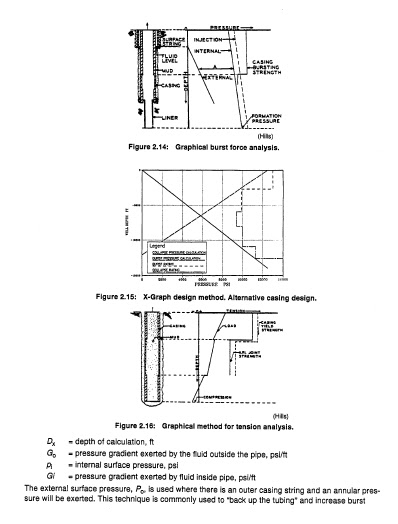
Burst force design may also be considered graphically, Figure 2.14.35 Eqn. 2.26 can be used to make the start of the X diagram of Figure 2.1 5. The X diagram is constructed
by collapse and burst c a l c ~ l a t i o n s . ’T~h~e ~m~a ximum burst line is drawn between the calculated burst at the surface and the calculated burst at the casing shoe. The collapse line is drawn between U and the maximum collapse pressure at the casing shoe, calculated by Eqn. 2.24 or 2.25. Tension design is the last step for each section of the casing string. The top of each section should be checked to see that the tensile ratings are not exceeded. The common safety factor is 1.6 to 1.8. When the tensile limits are exceeded, a change to a higher strength joint should be made. Tension limits may be gathered from a table of casing properties or calculated by dividing the API 5C3 value for joint strength by the safety factor

Chapter 2: Casing Design con't lec ( 7 )


Casing Weights and Grades
Common casing diameters range from less than 4-1/2 in. to over 20 in., and common tubing sizes are from 3/4 in. to over 4-1/2 in. In some high rate wells, tubing may be 5-1/2 in. to over 7 in. and 2-7/8 in. casing is run in tubingless completions. After the size is determined, the grade of the steel must be selected. The grades, along with weight, are based on pressure and corrosion requirements. The grades of steel used in oil industry tubulars
are shown in the following table for API and non-API sizes. The letters are assigned only to avoid confusion. Grades N-80 and stronger are considered high strength steels. Use of the higher strength steels increases cost and decreases resistance to some forms of corrosion. Use of the very hardalloys, such as V-150, makes packer setting difficult since the slips have difficulty setting in the very hard steel of the casing.


The yield and burst strength values for each casing size and weight are available from detailed tables are used for selection of casing once the necessary strength calculations are made. Often, because of economics or efforts to lighten the casing string, lower grade or lighter weight casing may be considered. Because the weight and pressure loads on a casing string change from top to bottom, a well designed string may incorporate several weights and grades of casing.


Casing Design Safety Factors

The design criteria for casing strings depends on the intended use and anticipated stresses. Because variance exists in both pipe manufacture and formation properties, safety factors must be incorporated into a design. The common ranges for safety factors in normal completion are shown b e l ~ w . ~ ~ ~ ~ Factors such as salt flows,7 very high pressures, sour service,8 reservoir compaction loads,g and thermal cycling'0 may change the safety factors.

tension                                               1.6 to 1.8
burst                                                 1.25 to 1.30
collapse                                            1 .O to 1.25


Earth shift forces, such as salt movement or other faulting and folding events caused by tectonic movement or are very difficult to address with a traditional safety factor. These forces have been successfully offset in some cases by designs using very heavy wall pipe or concentric pipe (casing cemented inside casing) over the affected zone. These types of casing designs are rare and most are generated by a series of trail and error approaches.

Load Description


The casing string must be designed for any load encountered from mud or reservoir fluids in placement or during any phase of stimulation or production. The common forces are tension during running, internal pressures during drilling, completion or production, and external pressures caused by drawdown, mechanical loads, and zone pressures. These loads are tension, burst, and collapse. The loads are often applied simultaneously in different parts of the string, and the forces may interact. The tension design of the casing string is made as if it were hanging free in air. A safety factor of 1.6 to 1.8 is applied to make allowances for a number of other tension factor^.^*^^'' These factors are briefly discussed in the following paragraphs. Collapse, burst, and tension forces are explained separately, but all must be satisfactorily accounted for in the final design. The design methods in this book result in a conservative design. Each design method is based on the worst possible case that could
occur during running. Collapse loading is force applied from outside the casing by either fluid pressure in a zone or earth shift forces. Forces from fluid pressure are collapse loadings while earth shift forces produce mechanical crush loadings. The largest collapse load from fluid pressure will usually be exhibited at the bottom of the string where hydrostatic pressure is greatest. The exception is an isolated, very high pressure zone. These zones are usually noted on the drilling record as places where kicks are taken.
The occurrence of earth shift zones from faults or salt movement are much harder to locate, especially on wildcats but may often show up on the drilling record as sticking points (not associated with mud cake buildup) or zones that have to be reamed or redrilled to get back to gauge hole size. The occurrence of salt zones are a very important tip to potential casing problem^.^ In one study area, 87% of the wells around a salt dome suffered some casing diameter reduction due to external, earth shift force.
’In the collapse design for fluid pressure, the worst case loading occurs with the unlikely combination of an empty casing string in a hole full of mud. A proper design, for effects of collapse only, would be a casing string that is strongest at the bottom and weakest at the top. Collapse is also affected by the effects of tension, which reduces the collapse rating or the “set depth limit” of the casing. As an object is pulled, it is more likely to lose diameter as it stretches in length. This thinning is a force in the same direction as collapse forces. Fortunately, the point at which the effect of tension induced “narrowing” of the string is at maximum is at the surface where effects of collapse pressure from hydrostatic pressure are the lowest. Burst pressure is a force applied from inside the casing by produced fluid pressures, hydrostatic mud load or addition of surface pressure during stimulation or workover operations. Since there is usually mud hydrostatic pressure along the outside of the casing before and during cementing, the net pressure or the difference between the pressure inside the casing and outside the casing will be used in the design of the casing. Unlike collapse, however, the shallower casing section is also important in the burst calculations from a safety standpoint. Burst pressures exerted by produced fluids are maximum at the surface (no offsetting hydrostatic load), while those exerted by mud is maximum at the bottom of the well. During fracturing, high burst loads may be exerted all along the string. Because collapse loads offset the burst load at the bottom of the string, the burst calculation is usually important above the “buoyancy neutral point.” This will be developed later. Tension is a force produced by the weight of the casing, the pressure differential, and the mud weights inside and outside the casing. It is largest at the top of the string and decreases with depth toward the bottom of the string. The tension load is partially offset by the buoyancy of the string in mud and is affected by pressure. When the pressure inside the tube rises, the pipe diameter is expanded and the length shortened or the tension is increased in a pipe that is anchored to prevent upward movement. When the pressure outside of a tube rises, the tube is elongated or the compression is increased if the
ends are fixed, Figure 2.6. Buckling failure in casing usually results from axial compression (lengthwise) overloading. The load produces ridges in the casing walls or corkscrewing of the tube. Either of these actions relieve compression, but the pipe is usually permanently yielded. The effects of buckling, Figure 2.7, is critical on the design of the casing string. The neutral point, Figure 2.8, is the dividing line between where buckling may occur and where it cannot occur in a tube that is evenly loaded around its radius. Above the neutral point, the tube is in tension and will not buckle. Below the neutral point, the upward buoyancy of the mud and other forces including pressure and mechanical loading place the tube in compression. Buckling can occur if the compressive load is more than the pipe can tolerate in the wellbore surroundings. The following information describes the neutral point, first in a theoretical manner and then in a practical way. There can be a neutral point in the casing or tubing string described by the formula:’*


When F, is algebraically greater than the right-hanc side of the equation, the pipe tends to be straldht. When F, is less than the equation, the pipe tends to buckle. When F, is equal to the equation, the neutral point is reached. The right-hand side of Eqn. (2.1) may also be referred to as the stability force. The true axial force will vary from point to point in the string, and will also vary over the life of the well. Typical considerations necessary to compute F, include the conditions at the time of cementing the casing or setting the packer in the case of tubing, as well as changes in the environment (temperature and pressure) to which the tubular is exposed. For casing, buckling primarily affects wear, particularly for intermediate strings through which additional drilling will occur. In extreme cases, splitting may
also be common. For tubing, the radial clearance between tubing and casing is usually sufficient to allow corkscrewing, often producing permanent deformation of the buckled portion of the string.

This equation is only appropriate for an open ended tube, clamped at both ends, with PO = 0 and AT = 0 , and ignoring weight. Under the unlikely conditions of a weightless string with no outside pressure, buckling in tension is possible. To illustrate the impact of Eqn. 2.2, consider a weightless tube that is open ended and subject to internal pressure only. For this loading, the only axial force is that due to ballooning given by Eqn. 2.2 and shown previously in Figure 2.6. As the inside pressure is increased, F, increases as 2pPjAis but the right hand side of Eqn. 2.1 increases as PjAi. The tube will not only buckle immediately, but will also buckle in tension.


Each zone or section of the casing string is checked for tensile requirements following collapse and burst calculations. In case of corrections made to a string design to compensate for tension load requirements, the order of selection is usually: (1) stronger connection, (2) higher grade (stronger steel), and (3) higher weight. Increasing connection strength and steel grade is preferred since they increase total string strength without adding significant weight. There are so many “premium” connections available that it is difficult to present a comprehensive data set. Tables of connection specifics are published yearly.37
For the sole purpose of casing collapse strength derating due to the effects of tension, a practical “buoyancy neutral point”, designated N.P., can be estimated by Eqn. (2.4) where:
The collapse resistance values given in the manufacturer tables are for casing that is not affected by axial load. In a well, the casing will be stressed by fluid pressures, Figure 2.9, mechanical bending forces, Figure 2.10, and tensile forces produced by the hanging weight of the casing. In collapse calculations, axial tension produces a reduction in collapse resistance. For purposes of this example, the axial tension is assumed to be from tension loads on a straight, free hanging pipe and not from bending loads.


Designing for forces involving earth shifts, highly deviated hole, sticking, reciprocating and rotating casing while cementing or running stresses, involves field optimization and the criteria for design differ from company to company. Earth shift design usually involves multiple strings of pipe or very heavy wall pipe across the problem zone. Problem zone recognition can often be made from drilling records where bit dragging (nonassociated with mud cake buildup) occurs long after a zone is drilled. Wells near salt domes or flows are considered likely prospects for formation movement.

Physics and Measurement lec ( 1 )


Like all other sciences, physics is based on experimental observations and quantitative measurements. The main objective of physics is to find the limited number of fundamental
laws that govern natural phenomena and to use them to develop theories that can predict the results of future experiments. The fundamental laws used in developing theories are expressed in the language of mathematics, the tool that provides a bridge between theory and experiment. When a discrepancy between theory and experiment arises, new theories must be formulated to remove the discrepancy. Many times a theory is satisfactory only under limited conditions; a more general theory might be satisfactory without such limitations. For example, the laws of motion discovered by Isaac Newton (1642–1727) in the
17th century accurately describe the motion of objects moving at normal speeds but do
not apply to objects moving at speeds comparable with the speed of light. In contrast,
the special theory of relativity developed by Albert Einstein (1879–1955) in the early 1900s gives the same results as Newton’s laws at low speeds but also correctly describes
motion at speeds approaching the speed of light. Hence, Einstein’s special theory of
relativity is a more general theory of motion. Classical physics includes the theories, concepts, laws, and experiments in classical mechanics, thermodynamics, optics, and electromagnetism developed before 1900. Important contributions to classical physics were provided by Newton, who developed classical mechanics as a systematic theory and was one of the originators of calculus as a mathematical tool. Major developments in mechanics continued in the 18th century, but the fields of thermodynamics and electricity and magnetism were not developed until the latter part of the 19th century, principally because before that time the apparatus for controlled experiments was either too crude or unavailable. A major revolution in physics, usually referred to as modern physics, began near the end of the 19th century. Modern physics developed mainly because of the discovery that many physical phenomena could not be explained by classical physics. The two most important developments in this modern era were the theories of relativity and quantum mechanics. Einstein’s theory of relativity not only correctly described the motion of objects moving at speeds comparable to the speed of light but also completely revolutionized the traditional concepts of space, time, and energy. The theory of relativity also shows that the speed of light is the upper limit of the speed of an object and that mass
and energy are related. Quantum mechanics was formulated by a number of distinguished
scientists to provide descriptions of physical phenomena at the atomic level. Scientists continually work at improving our understanding of fundamental laws, and new discoveries are made every day. In many research areas there is a great deal of overlap among physics, chemistry, and biology. Evidence for this overlap is seen in the names of some subspecialties in science—biophysics, biochemistry, chemical physics, biotechnology, and so on. Numerous technological advances in recent times are the result of the efforts of many scientists, engineers, and technicians. Some of the most notable developments in the latter half of the 20th century were
 (1) unmanned planetary explorations and manned moon landings,
 (2) microcircuitry and high-speed computers,
(3) sophisticated imaging techniques used in scientific research and medicine, and
(4) several remarkable results in genetic engineering. The impacts of such developments
and discoveries on our society have indeed been great, and it is very likely that
future discoveries and developments will be exciting, challenging, and of great benefit
to humanity.

1.1 Standards of Length, Mass, and Time

The laws of physics are expressed as mathematical relationships among physical quantities
that we will introduce and discuss throughout the book. Most of these quantities are derived quantities, in that they can be expressed as combinations of a small number of basic quantities. In mechanics, the three basic quantities are length, mass, and time. All other quantities in mechanics can be expressed in terms of these three. If we are to report the results of a measurement to someone who wishes to reproduce this measurement, a standard must be defined. It would be meaningless if a visitor from another planet were to talk to us about a length of 8 “glitches” if we do not know the meaning of the unit glitch. On the other hand, if someone familiar with our system of measurement reports that a wall is 2 meters high and our unit of length is defined to be 1 meter, we know that the height of the wall is twice our basic length unit. Likewise, if we are told that a person has a mass of 75 kilograms and our unit of mass is defined to be 1 kilogram, then that person is 75 times as massive as our basic unit.1 Whatever is chosen as a standard must be readily accessible and possess some property that can be measured reliably. Measurements taken by different people in different places must yield the same result. In 1960, an international committee established a set of standards for the fundamental quantities of science. It is called the SI (Système International), and its units of length, mass, and time are the meter, kilogram, and second, respectively. Other SI standards established by the committee are those for temperature (the kelvin), electric current (the ampere), luminous intensity (the candela), and the amount of substance (the mole).

Length

In A.D. 1120 the king of England decreed that the standard of length in his country
would be named the yard and would be precisely equal to the distance from the tip of
his nose to the end of his outstretched arm. Similarly, the original standard for the foot
adopted by the French was the length of the royal foot of King Louis XIV. This standard
prevailed until 1799, when the legal standard of length in France became the meter,
defined as one ten-millionth the distance from the equator to the North Pole along
one particular longitudinal line that passes through Paris. Many other systems for measuring length have been developed over the years, but the advantages of the French system have caused it to prevail in almost all countries and in scientific circles everywhere. As recently as 1960, the length of the meter was defined as the distance between two lines on a specific platinum–iridium bar stored under controlled conditions in France. This standard was abandoned for several reasons, a principal one being that the limited accuracy with which the separation between the lines on the bar can be determined does not meet the current
requirements of science and technology. In the 1960s and 1970s, the meter was defined
as 1 650 763.73 wavelengths of orange-red light emitted from a krypton-86 lamp. However, in October 1983, the meter (m) was redefined as the distance traveled by light in vacuum during a time of 1/299 792 458 second. In effect, this latest definition establishes that the speed of light in vacuum is precisely 299 792 458
meters per second.
Table 1.1 lists approximate values of some measured lengths. You should study this
table as well as the next two tables and begin to generate an intuition for what is meant
by a length of 20 centimeters, for example, or a mass of 100 kilograms or a time interval
of 3.2 ! 107 seconds.

Mass

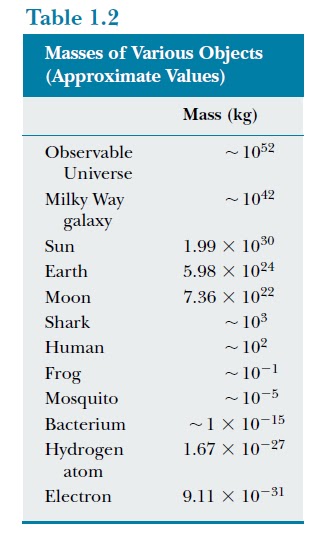
The SI unit of mass, the kilogram (kg), is defined as the mass of a specific platinum–iridium alloy cylinder kept at the International Bureau of Weights and Measures at Sèvres, France. This mass standard was established in 1887 and has not been changed since that time because platinum–iridium is an unusually stable alloy. A duplicate of the Sèvres cylinder is kept at the National Institute of Standards and Technology (NIST) in Gaithersburg, Maryland (Fig. 1.1a). Table 1.2 lists approximate values of the masses of various objects.

Time
Before 1960, the standard of time was defined in terms of the mean solar day for the
year 1900. (A solar day is the time interval between successive appearances of the Sun
at the highest point it reaches in the sky each day.) The second was defined as
of a mean solar day. The rotation of the Earth is now known to vary slightly with time, however, and therefore this motion is not a good one to use for defining a time standard.
In 1967, the second was redefined to take advantage of the high precision attainable
in a device known as an atomic clock (Fig. 1.1b), which uses the characteristic frequency
of the cesium-133 atom as the “reference clock.” The second (s) is now defined as
9 192 631 770 times the period of vibration of radiation from the cesium atom.2

To keep these atomic clocks—and therefore all common clocks and watches that are
set to them—synchronized, it has sometimes been necessary to add leap seconds to our
clocks.
Since Einstein’s discovery of the linkage between space and time, precise measurement
of time intervals requires that we know both the state of motion of the clock used
to measure the interval and, in some cases, the location of the clock as well. Otherwise,
for example, global positioning system satellites might be unable to pinpoint your location
with sufficient accuracy, should you need to be rescued.
Approximate values of time intervals are presented in Table 1.3.
In addition to SI, another system of units, the U.S. customary system, is still used in the
United States despite acceptance of SI by the rest of the world. In this system, the units of
length, mass, and time are the foot (ft), slug, and second, respectively. In this text we shall
use SI units because they are almost universally accepted in science and industry. We shall
make some limited use of U.S. customary units in the study of classical mechanics.
In addition to the basic SI units of meter, kilogram, and second, we can also use
other units, such as millimeters and nanoseconds, where the prefixes milli- and nanodenote
multipliers of the basic units based on various powers of ten. Prefixes for the
various powers of ten and their abbreviations are listed in Table 1.4. For example,
10"3 m is equivalent to 1 millimeter (mm), and 103 m corresponds to 1 kilometer
(km). Likewise, 1 kilogram (kg) is 103 grams (g), and 1 megavolt (MV) is 106 volts (V).


Mechanics

physics, the most fundamental physical science, is concerned with the basic principles of the Universe. It is the foundation upon which the other sciences—astronomy, biology, chemistry, and geology—are based. The beauty of physics lies in the simplicity of the fundamental physical theories and in the manner in which just a small number of fundamental concepts, equations, and assumptions can alter and expand our view of the world around us. The study of physics can be divided into six main areas:
1. classical mechanics, which is concerned with the motion of objects that are large
relative to atoms and move at speeds much slower than the speed of light;
2. relativity, which is a theory describing objects moving at any speed, even speeds
approaching the speed of light;
3. thermodynamics, which deals with heat, work, temperature, and the statistical behavior
of systems with large numbers of particles;
4. electromagnetism, which is concerned with electricity, magnetism, and electromagnetic
fields;
5. optics, which is the study of the behavior of light and its interaction with materials;
6. quantum mechanics, a collection of theories connecting the behavior of matter at
the submicroscopic level to macroscopic observations. The disciplines of mechanics and electromagnetism are basic to all other branches of classical physics (developed before 1900) and modern physics (c. 1900–present). The first part of this textbook deals with classical mechanics, sometimes referred to as Newtonian mechanics or simply mechanics. This is an appropriate place to begin an introductory text because many of the basic principles used to understand mechanical systems can later be used to describe such natural phenomena as waves and the transfer of energy by heat. Furthermore, the laws of
conservation of energy and momentum introduced in mechanics retain their importance
in the fundamental theories of other areas of physics. Today, classical mechanics is of vital importance to students from all disciplines. It is highly successful in describing the motions of different objects, such as planets, rockets, and baseballs. In the first part of the text, we shall describe the laws of classical mechanics and examine a wide range of phenomena that can be understood with these fundamental ideas.

Complete directional drilling operation video

Complete directional drilling operation
casing and cementing the hole by very good method


view here


support us

magnetic resonance image logging while drilling mril wd video

magnetic resonance image logging while drilling mril wd identify porosity and mobility of fluids


Chapter 2: Casing Design lec ( 6 )


Open Hole Completions

The first decision on casing the pay zone is not of size or weight but whether or not to run casing at all. Open hole completions represent the simplest type of completions and have some very useful traits. They also present some problems. An open hole or barefoot completion is usually made by drilling to the top of the pay, then running and cementing casing. After these operations, the pay is drilled with a nondamaging fluid. Since the other formations are behind pipe, the drilling fluid overbalance is only that needed to control the reservoir pressure. This creates less damage. Open hole completions have the largest possible formation contact with the wellbore, allowing injection or production with every part of the contacted interval. The effect of the open hole on stimulated operations depends on the type of job. Fracturing operations are often easier in the open hole than through perforations by less possibility of perforation screenouts, but the perforations may make the zone easier to break down since a crack (the perforation) has already been placed. Matrix acidizing can more evenly contact the entire zone in an open hole but is more difficult to direct by straddle packer than in a cased hole. Hydraulic jetting is most effective in the open hole. Productivity of open hole gravel packs, especially the underreamed open holes are usually much higher than cased hole gravel packs. Why then, are casing strings even used? Part of the answer is in formation (wellbore) stability concerns and part is unfamiliarity with completing and producing the open hole completions. A decision must be reached on the merits of the completions on the pay in question. If the pay is prone to brittle
failures during production that leads to fill, most operators choose to case and cement. In areas of water coning or zone conformance problems, casing may make isolation of middle or top zones possible. With the advent of improved inflatable packers and matrix sealants, however, isolation is also possible in open holes, although wellbore diameter may be severely restricted.

Cased Hole Completions

A casing string is run to prevent the collapse of the wellbore and to act in concert with the cement sheath to isolate and separate the productive formations. The size of the casing is optimized on the expected productivity of the well and must be designed to withstand the internal and external pressures associated with completion, any corrosive influences, and the forces associated with running the casing.
An optimum design for a casing string is one designed from "the inside out", a design that is based on supplying a stable casing string of a size to optimize total fluid production over the life of the well (including possibility of secondary or tertiary floods). The effective design of a casing string for any well consists of four principal steps.

1. Determine the length and size of all casing strings that are needed to produce the well to its maximum potential.
2. Calculate the pressure and loads from predicted production and operations such as stimulation, thermal application and secondary recovery.
3. Determine any corrosive atmosphere that the casing string will be subjected to and either select alloys which can resist corrosion or design an alternate corrosion control system.
4. Determine the weight and grade of casing that will satisfactorily resist all of the mechanical, hydraulic, and chemical forces applied.

The sizing of a casing string must be complete before finalizing the bit program during the planning of the well. A casing string can be visualized as a very long telescoping tube with the surface casing or conductor pipe as the first segment and the deepest production string or liner as the smallest, most extended section. Each successive (deeper) segment of the casing string must pass through the last section with enough clearance to avoid sticking. Figure 2.1 illustrates the way the casing string fits together. The drill bits used for each section are usually 1.5 to 3 in. or more larger than the casing 0.d. to be run. When one section is cased and cemented, a bit just small enough to pass through the casing
drift ID is run to drill to the next casing seat (casing shoe set depth). During drilling, departing from the bit program is often required, especially in a wildcat when the fluid pressures in the formations cannot be controlled with a single mud weight without either breaking down some formations by hydraulic fracturing with the mud, or allowing input of fluid from other formations because of low hydrostatic drilling mud pressure (a kick). Ideally, just before this noncontrollable point is reached, the “casing point” is designated and a casing string is run. Economics of drilling and cementing dictate that these casing points be as far apart as formation pressures and hole stability will allow. Use of as few casing strings as possible also permits larger casing to be used across the production zone without
using extremely large diameter surface strings.


Use of small casing severely restricts the opportunities for deepening the well or using larger pumps. Use of small casing to save on drilling costs is usually a poor choice in any area in which high production rates (including water floods) are expected.

Description of Casing Strings

There are several different casing strings that are run during the completion of a well. These strings vary in design, material of construction and purpose. The following paragraphs are brief descriptions of the common required strings and specialty equipment.
 The conductor pipe is the first casing which is run in the well. This casing is usually large diameter and may be set with the ”spudding” arm on the rig (The spudding arm drives in the casing.). The primary purpose of the conductor casing is as a flow line to allow mud to return to the pits and to stabilize the upper part of a hole that may be composed of loose soil. The depth of the conductor pipe is usually in the range of 50-250 ft with the depth set by surface rocks and soil behavior. It also provides a point for the installation of a blow-out preventer (BOP) or other type of diverter system. This allows any shallow
fluid flows to be diverted away from the rig, and is a necessary safety factor in almost all areas. In areas with very soft and unconsolidated sediments, a temporary outer string, called a stove pipe, may be driven into place to hold the sediment near the surface.
The well is drilled out from the conductor pipe to a depth below the shallow fresh water sands. The surface casing string is run through the conductor pipe and has three basic functions: (1) it protects shallow, fresh-water sands from contamination by drilling fluids, (2) prevents mud from being cut with brines or other water that may flow into the wellbore during drilling, and (3) it provides sufficient protection of the zone to avoid fracturing of the upper hole so that the drilling may proceed to the next casing point. This surface casing is cemented in place over the full length of the string and is the second line of safety for sealing the well and handling any high pressure flow. The intermediate string is the next string of casing, and it is usually in place and cemented before the higher mud weights are used. It allows control of the well if subsurface pressure higher than the mud
weight occurs and inflow of fluids is encountered. This inflow of well fluids during drilling or completion of the well is called a kick and may be extremely hazardous if the flowing fluids are flammable or contain hydrogen sulfide (sour gas). The intermediate casing may or may not be cemented in place and, if not cemented, may be removed from the well if an open-hole completion is desired. If a casing string is not hung from the surface, but rather hung from some point down hole, it is called a “liner”. In most wells, the top of the liner is cemented in place to provide sealing. The top of the liner is set inside an upper casing string. The section where the liner runs inside another string is the overlap
section. Production liners are permanent liners that are run through the productive interval. On some occasions] they may be run back to surface in a liner tieback operation. The tieback consists of a downhole mechanical sealing assembly in a hanger into which a linear string or the tie back string is “stabbed” to complete the seal. A cement job seals the liner into place in the casing and prevents leakage from the formation into the casing. The lower part of the casing string, into which the liner is cemented, is called the overlap section. Overlap length is usually only enough to insure a good seal, typically 300 to
500 ft. Overlap length may be longer where water or gas channeling would create a severe problem. Liners are run for a variety of reasons. If the operator wants to test a lower zone of dubious commercial quality, a liner can be set at less expense than a full casing string. Also, in lower pressure areas where multiple strings of pipe up to the surface are not necessary to control corrosion or pressure, the liner can be an expense-saving item. In wells that are to be pumped by ESP’s (Electric Submersible Pumps), the liner through the production section leaves full hole diameter in the casing string above the pay for setting large pumps and equipment. The production casing, or the final casing run into the well, is a string across the producing zone that is hung from the surface and may be completely cemented to the surface. This string must be able to withstand the full wellhead shutin pressure if the tubing or the packer fails. Also, it must contain the full bottomhole pressure and any mud or workover fluid kill weight when the tubing or packer is removed or replaced during workovers. The decision on whether to cement the full string is based on pressure
control, economics, corrosion problems, pollution possibilities and government regulations.

Casing Clearance

The necessary clearance between the outside of the casing and the drilled hole will depend on the hole and mud condition. In cases where mud conditioning is good or the mud is lightweight and the formations are competent, a clearance of 1.5 in. total diameter difference is acceptable. For this clearance to be usable, the casing string should be short. Primary cementing operations may not be successful in this clearance and cementing backpressures will be high. A better clearance for general purpose well completions is 2 to 3 in. For higher mud weights, poorer mud conditioning, poor quality hole and higher formation pressures, clearance should be increased. For more information on hole quality and sticking, review the chapter on Drilling the Pay. Excessive clearances should also be
avoided. If the annular area is too large, the cement cannot effectively displace the drilling mud.
A reference for hole size and casing size for single or multiple string operations are shown in
Figure 2.2.2 The solid lines indicate the common biffcasing combinations with adequate clearance for most operations. The dashed lines indicate less common (tighter) hole sizes or bitkasing combinations. Long runs of casing through close clearance holes usually leads to problems. Tight clearances should be avoided where possible.


Connections
The threaded connection of casing or tubing is important because of strength and sealing considerations. The connections are isolated pressure vessels that contain threads, seals and stop shoulder^.^ The fluid seal produced by a connection may be created in the threads by a pipe dope fluid or by a metal or elastomer seal within the connection. Strength of the connection may range from less than pipe body strength to tensile effciencies of over 11 5% of pipe body ~t rengthT.~hr eads are tapered and designed to fit a matching thread in a particular collar. In the API round thread series, the connection may be either short thread and coupling (ST&C) or long thread and coupling (LT&C) as illustrated in Figure 2.3. If the thread is an eight round, it means eight threads per inch. The length description
refers to the relative length of the coupling and the amount of pipe that is threaded (the pin). Creation of a pressure tight seal with an API round thread requires filling the voids between the threads with a sealing compound (thread dope) during makeup of the joint.


Although the standard 8-round threaded connection is reasonably strong, it does not approach the strength of the body of the pipe. As tensile loads increase toward the limit of the pipe, the connection will normally fail by shearing off the threads from the pipe or by thread jumpout caused by pipe deformation under severe loads.
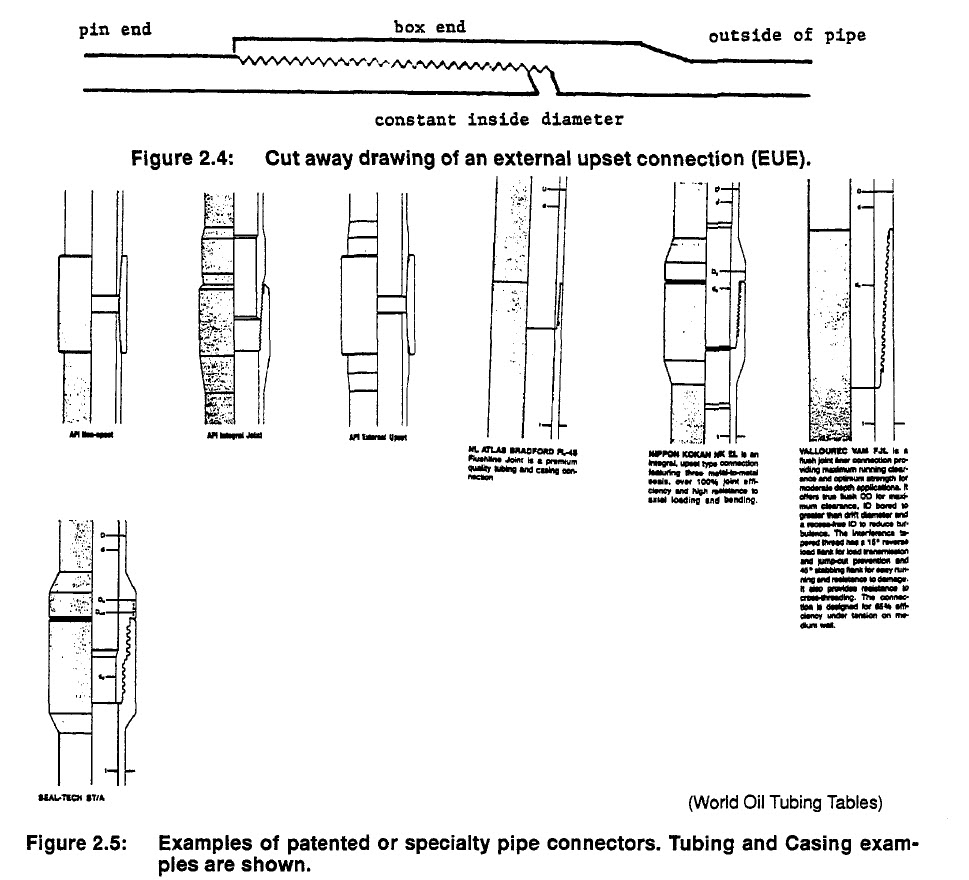
To make a stronger joint in tubing, a thicker (larger outside diameter) section is left at the end of the pipe so that threads can be cut without making the wall thickness of the pipe thinner than in the body. This form of connection is called external upset or EUE, Figure 2.4. Its inside diameter is the same as the pipe. A nonupset, or NU pipe and several other joint types are shown in Figure 2.5 The outside diameter of the EUE joint is larger than the NU connection, and the coupling or collar is normally manufactured on the pipe. Another method of increasing the strength of the threaded connection is by upsetting the connection to the inside of the pipe. This internal upset restricts the inside diameter of the pipe at every joint and is only used in drill pipe where a constant outside diameter is necessary.
Other sealing surfaces are available in special connections and have found popularity where rapidly made, leak free sealing is important. The two-step thread connection uses two sets of threads with a metal sealing surface between. In other connections, a groove at the base of the box may contain an elastomer seal. A variety of connection types and sealing surfaces are available, Figure 2.5. The disadvantage to the numerous thread and sealing combinations is that the connections cannot be mixed


in a string without crossovers (adaptors). A more detailed discussion of connections are available from other sources.