Chemical Reactor Design - Peter Harriott free download


content


Preface
Appendix Diffusion Coefficients for Binary Gas Mixtures
1. Homogeneous Kinetics
Definitions and Review of Kinetics for Homogeneous Reactions
Scaleup and Design Procedures
Interpretation of Kinetic Data
Complex Kinetics
Nomenclature
Problems
References
2. Kinetic Models for Heterogeneous Reactions
Basic Steps for Solid-Catalyzed Reactions
External Mass Transfer Control
Models for Surface Reaction
Rate of Adsorption Controlling
Allowing for Two Slow Steps
Desorption Control
Changes in Catalyst Structure

Catalyst Decay
Nomenclature
Problems
References
3. Ideal Reactors
Batch Reactor Design
Continuous-Flow Reactors
Plug-Flow Reactors
Pressure Drop in Packed Beds
Nomenclature
Problems
References
4. Diffusion and Reaction in Porous Catalysts
Catalyst Structure and Properties
Random Capillary Model
Diffusion of Gases in Small Pores
Effective Diffusivity
Pore Size Distribution
Diffusion of Liquids in Catalysts
Effect of Pore Diffusion on Reaction Rate
Optimum Pore Size Distribution
Nomenclature
Problems
References
5. Heat and Mass Transfer in Reactors
Stirred-Tank Reactor
Reactor Stability
Packed-Bed Tubular Reactors
Radial Heat Transfer in Packed Beds
Alternate Models
Nomenclature
Problems
References
6. Nonideal Flow
Mixing Times
Pipeline Reactors
Packed-Bed Reactors
Nomenclature

Problems
References
7. Gas–Liquid Reactions
Consecutive Mass Transfer and Reaction
Simultaneous Mass Transfer and Reaction
Instantaneous Reaction
Penetration Theory
Gas-Film Control
Effect of Mass Transfer on Selectivity
Summary of Possible Controlling Steps
Types of Gas–Liquid Reactors
Bubble Columns
Stirred-Tank Reactors
Packed-Bed Reactors
Nomenclature
Problems
References
8. Multiphase Reactors
Slurry Reactors
Fixed-Bed Reactors
Nomenclature
Problems
References
9. Fluidized-Bed Reactors
Minimum Fluidization Velocity
Types of Fluidization
Reactor Models
The Two-Phase Model
The Interchange Parameter K
Model V: Some Reaction in Bubbles
Axial Dispersion
Selectivity
Heat Transfer
Commercial Applications
Nomenclature
Problems
References
10. Novel Reactors
Riser Reactors

Monolithic Catalysts
Wire-Screen Catalysts
Reactive Distillation
Nomenclature
Problems
References

CHEMICAL ENGINEERING DESIGN PROJECT free download


content
Introduction 1
I How to Use This Book 1
(A) The Case Study Approach 1
(B) A "Road Map" 2
II Some Advice 3
(A) General Advice to the Student 3
(B) Advice from a Former Design Project Student 4
(C) To the Lecturer 5
(D) The Designer or Project Engineer 7
III Presentation of Design Projects 7
(A) Effective Communications 7
(B) General Comments on Preparation of Literature Surveys 9
IV Details of Particular Design Projects, and Information Sources 14
(A) IChemE Design Projects 14
Instructions for the IChemE Design Project, 1980 16
(B) Information Sources 20
PART 1 TECHNICAL AND ECONOMIC FEASIBILITY STUDY
Chapter 1 The Design Problem 27
1.1 Initial Considerations and Specification 27
1.1.1 The Feasibility Study 27
1.1.2 Time Management 28
1.1.3 Stages in a Design Problem 28
1.1.4 The Search for Information 28
1.1.5 Scope of the Project 29
1.1.6 Evaluating the Alternatives - Making Decisions 29
Some Questions to Ask for the Chemical to be Produced 30
Further Reading 30
Case Study: Production of Phthalic Anhydride 31
Overall Summary for the Technical and Economic Feasibility Study 31
1.2 Case Study - Defining the Problem and Background Information 32
Summary 32
1.2.1 Background and Objectives 32
1.2.2 Chemical Structure and Physical Properties 32
1.2.3 Applications and Uses 33
1.2.4 Basic Chemistry 33
1.2.5 Evaluation of Alternative Processing Schemes 34
1.2.6 Conclusions 35
1.2.7 Recommendations 35
Chapter 2 Feasibility Study and Market Survey 37
2.1 Initial Feasibility Study 37
2.2 Preliminary Market Survey/Economic Analysis 37
References 40
2. 3 Information Sources 40
2.4 Evaluation of Available Literature 41
2.5 Considerations for Literature Surveys 42
References 42
2.6 Case Study - Feasibility Study and Market Assessment 43
Summary 43
2.6.1 Market Assessment 43
2.6.1.1 Production: Worldwide 43
2.6.1.2 Production: Regional 44
2.6.1.3 Production: National 44
2.6.2 Current and Future Prices 45
2.6.3 Demand 45
2.6.4 Australian Imports and Exports 46
2.6.5 Plant Capacity 46
2.6.6 Product Value and Operating Costs 47
2.6.6.1 Capital Costs 47
2.6.6.2 Operating Costs 47
2.6.6.3 Approximate Selling Price 47
2.6.7 Conclusions 48
2.6.8 Recommendations 49
Chapter 3 Process Selection, Process Description and Equipment List 51
3.1 Process Selection Considerations 51
3.1.1 Flow Diagrams - PFD and P&ID 51
3.1.2 The Reactor 51
3.1.3 Product Purity 52
3.1.4 Process Conditions 52
3.1.5 Process Data 52
3.1.6 Energy Efficiency 52
3.1.7 Factors in Process Evaluation and Selection 53
3.1.8 Choices and Compromises 53
3.1.9 The Optimum Design 54
3.1.10 Process Control and Instrumentation 54
References 54
3.2 Process Description 55
3.3 Preparing the Equipment List 55
3.4 Rules of Thumb 56
3.5 Safety Considerations and Preliminary HAZOP Study 57
References 57
3.6 Case Study - Process Selection and Equipment List 58
Summary 58
3.6.1 Trends in Phthalic Anhydride Processing 58
3.6.2 Raw Material 58
3.6.3 Process Configurations 59
3.6.4 Detailed Process Description 61
3.6.5 Advantages of the LAR Process 62
3.6.6 Advantages of the LEVH Process 62
3.6.7 Process Selection 62
3.6.8 Initial Equipment Design 63
3.6.9 Equipment List 63
3.6.10 Conclusions 64
3.6.11 Recommendations 64
Appendix A: Preliminary Equipment Specifications 65
Chapter 4 Site Considerations: Site Selection and Plant Layout 69
4.1 Site Selection/ Location 69
4.1.1 Local Industrial Areas 69
4.1.2 Some Important Factors 70
4.1.3 Prioritizing the Factors 70
References 71
4.2 Plant Layout 71
4.2.1 Plant Layout Strategies 72
4.2.2 Factors Influencing Plant Layout 72
References 73
4.3 Case Study - Site Considerations: Site Selection and Plant Layout 74
Summary 74
4.3.1 Background and Objectives 74
4.3.2 Potential Sites 75
4.3.2.1 Kemerton 76
4.3.2.2 Geraldton 76
4.3.3 Preferred Site and Layout 76
4.3.4 Conclusions 80
4.3.5 Recommendations 81
Chapter 5 Environmental Considerations 83
5.1 Environmental Impact Assessment 83
5.2 General Considerations 83
5.3 EIA Policy and Scope 85
5.4 EIA Reports 86
5.5 Australia 88
5.6 United Kingdom 88
5.7 United States 89
5.8 ISO-14000 90
5.9 Legislation 90
References 91
5.10 Case Study - Environmental Considerations 92
Summary 92
5.10.1 Purpose 93
5.10.2 Airborne Emissions 93
5.10.3 Waterborne Emissions 95
5.10.4 Solid Waste 95
5.10.5 Process Hazards 96
5.10.6 Accidental Spills and Tank Breaches 96
5.10.7 Personnel Safety Precautions and Procedures 98
5.10.8 Conclusions 98
5.10.9 Recommendations 99
Chapter 6 Economic Evaluation 101
6.1 Introductory Notes 101
6.2 Capital Cost Estimation 102
6.2.1 Cost of Equipment (Major Items) 103
(I) Cost Correlations 103
(II) Factored Estimate Method 104
6.2.2 Module Costs 105
6.2.3 Auxiliary Services 105
6.3 Operating Costs - Fixed and Variable 106
6.3.1 Depreciation 108
6.4 Profitability Analysis 109
6.4.1 The Payback Period 110
6.4.2 Return on Investment (ROI) 110
6.4.3 Evaluating Different Scenarios 110
6.4.4 Economic Evaluation and Analysis 111

Use of Descriptive Statistical Indicators for Aggregating Environmental Data in Multi-Scale European Databases


On the basis of this study, the following conclusions can be drawn:
  •  The multi-scale nested grids approach can be proposed as a solution in many cases
where the data owner does not allow the distribution/publication of detailed data
but is willing to distribute degraded data (in coarser resolution). The aggregation
methodology can be considered a valuable one which contributes to the
degradation (without losing the real values) of very detailed data and may allow
the scientific community to access valuable information without having any
copyright problems.
  •  For a number of reasons upscaling can be useful in soil science domain: respect of
privacy and data ownership, easy adaptation to model requirements, update of spatial
databases in various scales and simplification of thematic maps.
  •  Upscaling methodology has proven to be good enough for identification of “data
patterns”. The upscaling process can easily identify if soil data have been downscaled
before a possible aggregation for reporting reasons.
  •  Upscaling has a serious drawback in case the source dataset in the finer scale has high
spatial variability. This has been shown in the upscaling process from 1km2 towards the
10km2. The descriptive statistics show the smooth effect that upscaling may cause in
high variability cases. Upscaling involves recognition of general pattern in data
distribution and this can be considered an advantage for environmental indicators. In
any case the upscaled output doesn’t represent the real world but it is a smooth
approximation. The upscaling from local scale to upper scales involves trade-offs and
compromises.
  • Despite the limitations, the scale transfer method presented here was well-suited to
the data and satisfied the overall objective of mapping soil indicators in coarser scale
giving appropriate responses to policy makers. Moreover, a series of newly
introduced concepts/indicators such as “Non-Perfect Square” Coverage, Correlation
Coefficient for predictions and Lost of Variation can be introduced for further
research and evaluation.
  •  Digital Soil Mapping (DSM) offers new opportunities for the prediction of

Petroleum Geology course ( lec 2 )


Rocks and Minerals

Rock is a naturally occurring aggregate of minerals.
A Mineral is a naturally occurring substance formed through geological processes that has a
characteristic chemical composition, a highly ordered atomic structure and specific physical
properties.


Rock Types

1- Igneous Rocks:
                                           are formed when molten magma cools off.

Igneous Rocks two types also:

    A- Plutonic (Intrusive) Rocks: Form when magma cools      and crystallizes slowly within the Earth’s crust (Granite)

   B- Volcanic (Extrusive) Rocks: Form when magma reaches the surface (Pumice and Basalt)


Basalt (Igneous Volcanic)

The tracks in the rock indicate the way of the lava flow

2 - Metamorphic Rocks: 
Rocks which have been modified in their original compositions by
means of heat, pressure and chemical alterations applied to them

two types also:
a- Foliated metamorphic rocks: have a layered or banded appearance that is produced by exposure to heat and directed pressure; Gneiss, Phyllite, Schist 
b- Non-foliated metamorphic rocks: Do not have a layered or banded appearance; Marble, Quartzite
3 - Sedimentary Rocks: 
 are formed by the accumulation of sediments

Sedimentary Rocks (Classification based on the source of their Sediments)

a- Clastic: Form from rocks that have been broken down into fragments by weathering and erosion followed by transportation; Breccia, Conglomerate, Sandstone, Shale
 
b- Chemical: Form when dissolved materials precipitate from solution; Rock Salt (Halite), Limestone
 
c- Organic: Form from the accumulation of plant or animal debris; Coal


Sedimentary Rocks” cover 75-80% of the Earth's land
area and are the most Important group of rocks in
Petroleum Geology
 
enjoy with us 
like our page in facebook
 

Petroleum Geology course ( lec 1 )

Course Objectives:

1) To introduce you to petroleum geology, specifically the origins and types
of hydrocarbons and the locations of hydrocarbon (sedimentary basins,
reservoirs, traps, seals).
2) To introduce you to exploration techniques; seismics and interpretation,
well logs and interpretation, new technologies (Satellite techniques)


Useful Sources:
1 - Elements of Petroleum Geology by Richard Selley, Academic Press, 1998
2 - Geology and Geochemistry of oil and gas by George Chilingar, Elsevier Publication, 2005


Dynamic Earth 
 
 
Dimensions of Earth’s Dynamics – Multidimensional


Dimensions of Earth’s Dynamics - Temporal


Geology in a descending view


Foam party: Rare phenomenon hits the coast of Melbourne

Foam party: Rare phenomenon hits the coast of Melbourne


Rare Phenomenon at Beach

show here


Strange Rare Phenomena Over Mt Ruapehu UFO

Rare Phenomenons


Rare Rainbow Cloud ( Circumhorizontal Arc ).

nice video


Gas Lift

Gas Lift

Gas lift provides artificial lifting energy by the injection of gas into or beneath the
fluid column. The gas decreases the fluid density of the column and lowers the
bottomhole pressure, allowing the formation pressure to move more fluid into the
wellbore. Injected gas bubbles also expand as they rise in the tubing above their
injection point, pushing oil ahead of them up the tubing. The degree to which each of
these mechanisms affects the well's production rate depends on the type of gas lift
method applied: continuous flow or intermittent flow.
Continuous flow gas lift relies on the constant injection of gas-lift gas into the
production stream through a downhole valve ( Figure 1 ).


The installation can be designed to allow for injection from the casing/tubing annulus
into the tubing (most common), for injection into a smaller concentric tubing string
within the production tubing ("macaroni" string), or for injection from the tubing into
the casing/tubing annulus (annular flow installation). The fluid column above the
injection point is lightened by the aeration caused by the relatively low density gas.
The resulting drop in bottomhole pressure causes an increase in production rate.


Intermittent gas lift ( Figure 2 ) allows for the buildup of a liquid column of produced
fluids at the bottom of the well-bore.


At the appropriate time, a finite volume of gas is injected below the liquid and
propels it as a slug to the surface. The propelling gas may be injected at a single
point below the liquid slug or may be supplemented by multipoint injection as the
slug moves past successive valves. An intermitter at the surface controls the timing
of each injection-production cycle. Intermittent gas lift is used on wells with low fluid
volumes, a high productivity index and low bottom-hole pressure, or a low
productivity index and high bottomhole pressure. Gas lift is a very flexible artificial
lift method. A properly designed installation can produce efficiently at a rate as high
as 1000 bbl/D (159 m3/d) or as low as 50 bbl/D (7.9 m3/d).
There are a number of gas-lift valves that are used in gas-lift operations. They are
distinguished by their sensitivity to the casing and/or tubing pressures needed to
open and close them ( Figure 3 ,


pressure operated , Figure 4 , fluid-operated, and Figure 5 , throttling valve).


The casing pressure-operated valve (also called a pressure valve) requires a buildup
in casing pressure to open and a reduction in casing pressure to close.


Fluid-operated valves require a buildup in tubing pressure to open and a reduction in
tubing pressure to close. A throttling pressure valve is sensitive to tubing pressure in
the open position, and once opened by casing pressure buildup, requires a reduction
in tubing or casing pressure to close.
For a specific gas-lift design, the valves will be located at appropriate intervals in the
tubing string. The type of valve and its location will depend on the expected flow
characteristics of the well over its lifetime, whether continuous or intermittent gas lift
is to be used, and whether the upper valves are to be used for simply unloading the
fluid in the annulus or for multipoint injection.
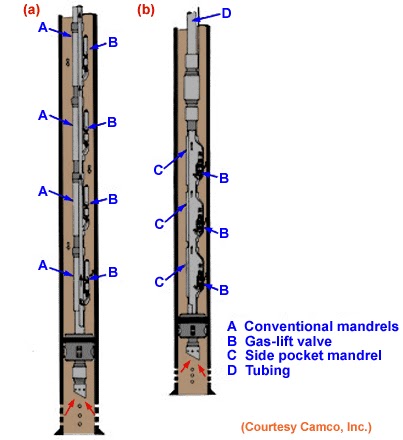
Conventional gas-lift valves are attached to gas-lift mandrels and wireline retrievable
gas-lift valves are set in side-pocket mandrels ( Figure 6 , (a) conventional, (b)
wireline retrievable ).


For conventional valves to be changed or serviced, the entire tubing string must be
pulled, while retrievable valves can be latched and set through tubing with a wireline
unit.