MUD RHEOLOGY


Rheology is the study of
how matter deforms and flows 
VISCOSITY
Resistance to flow of a fluid
FUNNEL VISCOSITY


  • 100 centipoise (cp)  =  1 poise
  • Centipoise is the dimension used to express:
  • Plastic viscosity
  • Apparent viscosity
  • Effective viscosity
  • The dimensions of lb/100 sq ft are used for expressing:
  1. -Yield point
  2. - Initial gel
  3. - 10-minute gel
 SHEAR  STRESS
  • Internal force that resists flow
  • System pressure loss (circulating pressure on the rig)
  • Simulated by the dial reading on a V G meter
SHEAR RATE

The velocity at which one layer of fluid moves past another
  • The bulk (average) velocity at which a fluid is moving
  • Annular velocity in the circulating system is an example of bulk velocity
  • Velocity is the RPM on a V G meter
Viscosity

Factors Influenced by Mud Rheology
  • Hole cleaning
  • Suspension of solids
  • Hole stability
  • Solids control
  • Equivalent circulating densities
  • Surge / swab pressures 
Measurement - Rotational Viscometer
Effect of Temperature & Pressure
  • Temperature reduces viscosity
  • Pressure increases viscosity
  • High temperature
  1. Breakdown of polymers
  2. Gelation of solids
    Plastic Viscosity

    • Resistance to flow due to mechanical frictio
    • Affected by:
    1. Solids concentration
    2. Size and shape of the solids
    3. Viscosity of the fluid phase
     Plastic Viscosity Increased by:

    Hydratable Drill Solids

    Clays, shales

    Inert Drill Solids

    Sand, limestone, etc.

    Colloidal Matter

    Starch, CMC
     
    Particles breaking, thus increasing surface area and more friction
    Weight material to increase density
     Area Increase by Breaking of Solids
     Effect of Particle Size on Viscosity


     Plastic Viscosity Decreased by
    Removal of Solids
    Shale shaker
    Desanders, desilters, and centrifuges
    Lowering of gel strength allows larger particles to settle out
    Dilution of solids with water
    How Solids Affect Mud Viscosity

    oil spill gulf gulf gulf oil mexico oil spill mexico gulf of mexico oil spill bp bp bp oil oil spill 2010 bp gulf gulf of mexico gulf oil mexico obama oil spill oil spill 2010 oil spill bp  oil spill florida oil spill gulf
    US sues BP, 8 other companies in Gulf oil spill Gulf oil spill recovery exec dead in plane crash Ex-CEO says BP was unprepared for oil spill BP's oil spill costs grow Scientists to see if oil spill hurt deep sea life Depression soars among Gulf residents after oil spill BP spent $93M on advertising after Gulf oil spill

Basic Petroleum Geology and Log Analysis

Geology is the science that deals with the history and structure of the earth and its life
forms, especially as recorded in the rock record. A basic understanding of its concepts
and processes is essential in the petroleum industry, for it is used to predict where oil
accumulations might occur. It is the job of the petroleum geologist to use his/her
knowledge to reconstruct the geologic history of an area to determine whether the
formations are likely to contain petroleum reservoirs. It is also the job of the geologist to
determine whether the recovery and production of these hydrocarbons will be
commercially profitable.
The physical characteristics of a reservoir, how petroleum originated and in what type of
rock, what types of fluids exist in the reservoir, how hydrocarbons become trapped, and
basic well log analysis are some of the concepts vital to the production and recovery
efforts of any exploration or energy service company.oil spill

Carl Gatlin - Drilling Well Completion

 Carl Gatlin - Drilling Well Completion


METHODS OF DEFLECTING A WELLBORE con't 3

Downhole Motor

  • Turbodrills have been around for many years but are seldom used for directional drilling 
  • Turbodrills have very high rotary speeds (500 to 1200 rpm)  
  • Because of the high rpm, bit life is limited
  • Diamond and PDC bits are more applicable to turbodrills
  • Turbodrills have low starting torque
  • If the motor is in a bind, it is hard to get the motor started
  • Turbodrills are used in directional drilling where the temperature exceeds the limit of a positive displacement motor
Positive displacement motors were introduced in the 1960’s


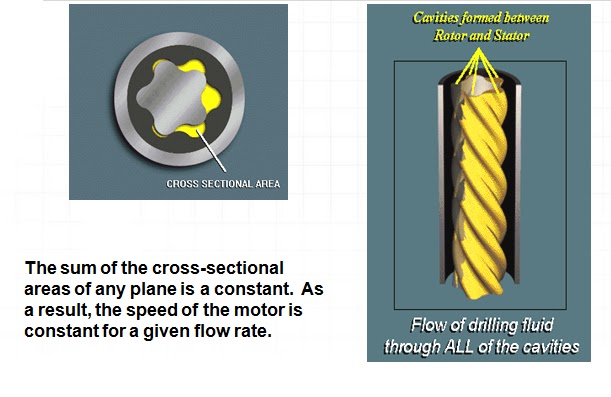
Rotor/stator configuration


Speed (RPM) / Torque (Ft-Lbs.)


  • For best performance, the power section should be matched to the bit and formation being drilled.  The speed and torque of a power section is directly linked to the number of lobes on the rotor and stator.  The higher the number of lobes, the higher the torque and the lower the RPM.
 

Dump sub
  •         Not often used
  •   Allows string to fill or drain when tripping
  •   Allows low volume circulation in stuck bit situations
 
Power pack section
Rotor is hard
Stator is flexible
Stator housing is thin
PDM is not a drill collar
 
 
  •  Reverse application of the Moineau pump principle
  •  Elastomer lined - steel tube stator
  •  Chrome  coated steel rotor
  •  Converts Hydraulic HP (flow & pressure) to Mechanical HP (rpm & torque) There are three main producers of motor  power sections in the world:
 
Typical PDM power curve
 
  •  Rotor is coupled to transmission
  •  Transmission shaft is coupled to the bearing pack
  •  The adjustable bent housing enables the bend to be changed at the wellsite
  •  The housing can be adjusted 0.26 to 3.0 degrees depending upon motor size
  
Bearing function
  •   On bottom thrust bearings carry force from the bit    (WOB)
  •   Off bottom thrust bearings carry the hydraulic load  of the mud and weight of the rotor
  •   Radial bearings carry side loads
  •   Flow restrictor diverts a portion of the mud for    lubrication

Advanced Reservoir Engineering

Advanced
Reservoir
Engineering


Tarek Ahmed
Senior Staff Advisor
Anadarko Petroleum Corporation
Paul D. McKinney
V.P. Reservoir Engineering
Anadarko Canada Corporation

Dedication

This book is dedicated to our wonderful and understanding wives, Shanna Ahmed and Teresa McKinney, (without whom this
book would have been finished a year ago), and to our beautiful children (NINE of them, wow), Jennifer (the 16 year old
nightmare), Justin, Brittany and Carsen Ahmed, and Allison, Sophie, Garretson, Noah and Isabelle McKinney.


The primary focus of this book is to present the basic
physics of reservoir engineering using the simplest and
most straightforward of mathematical techniques. It is only
through having a complete understanding of physics of
reservoir engineering that the engineer can hope to solve
complex reservoir problems in a practical manner. The book
is arranged so that it can be used as a textbook for senior
and graduate students or as a reference book for practicing
engineers.
Chapter 1 describes the theory and practice of well testing
and pressure analysis techniques, which is probably one
of the most important subjects in reservoir engineering.
Chapter 2 discusses various water-influx models along with
detailed descriptions of the computational steps involved in
applying these models. Chapter 3 presents the mathematical
treatment of unconventional gas reservoirs that include
abnormally-pressured reservoirs, coalbed methane, tight
gas, gas hydrates, and shallow gas reservoirs. Chapter 4
covers the basic principle oil recovery mechanisms and the
various forms of the material balance equation. Chapter 5
focuses on illustrating the practical application of the MBE
in predicting the oil reservoir performance under different
scenarios of driving mechanisms. Fundamentals of oil field
economics are discussed in Chapter 6.  

oil spill gulf gulf gulf oil mexico oil spill mexico gulf of mexico oil spill bp bp bp oil oil spill 2010 bp gulf gulf of mexico gulf oil mexico obama oil spill oil spill 2010 oil spill bp  oil spill florida oil spill gulf